Updated: May 2026
A Luxury Liveaboard Dive Route Through the Banda Islands
- Exploration of over 15 distinct dive sites from Ambon to the southern Spice Islands.
- A combination of world-class diving, cultural immersion, and five-star onboard service.
- A route timed for optimal marine migrations between September and December.
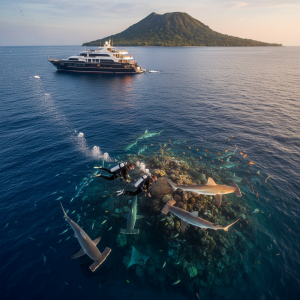
The air, thick with the scent of nutmeg and clove, rolls off the island of Banda Neira and across the calm, obsidian water of the caldera. From the bow of the Amandira, our 52-meter custom-built phinisi, the volcanic cone of Gunung Api pierces a low-slung cloud, its presence a constant, powerful reminder of the forces that shaped this archipelago. Below deck, the dive team is making final checks on the nitrox blends. This is not merely a dive trip; it is an immersion into a living maritime museum, a journey back to the epicenter of the 16th-century spice trade, and the beginning of an memorable liveaboard dive route through the Banda Islands.
Charting the Course: Ambon, The Gateway to the Spiceries
Every great expedition requires a strategic starting point, and for the Banda Sea, that port is Ambon. While many see it as a logistical necessity—a place to land at Pattimura Airport (AMQ) and board the vessel—the diving cognoscenti know Ambon Bay for what it truly is: one of the world’s premier muck diving destinations. Our cruise director, a marine biologist from France named Jean-Luc, briefs us on the first evening. “Forget the wide-angle lenses for the first 24 hours,” he advises, tapping a chart of Ambon Bay. “Here, we hunt for the bizarre.” The sites, with names like Laha and Twilight Zone, are located just minutes from the main port. They lack the crystalline visibility of the outer islands, often sitting at 10-15 meters, but the payoff is immense. Within two dives, our logs are filled with sightings of Ambon scorpionfish, flamboyant cuttlefish, and a half-dozen species of frogfish. It is a macro photographer’s paradise, a gentle submersion into the strange wonders of the Indo-Pacific before we weigh anchor and point the bow southeast, into the vastness of the Banda Sea. The transition from the concentrated, silty bottom of the bay to the deep, clear blue of the open ocean is a palpable shift in the expedition’s character.
Nusa Laut and the Promise of Pristine Reefs
Our first overnight passage, a smooth 40-nautical-mile cruise, brings us to the shores of Nusa Laut. This small island represents a crucial chapter in the story of Indonesian marine conservation. Here, the local community of Amed has, for decades, enforced a traditional marine protection system known as “sasi,” which prohibits fishing on certain reefs to allow them to recover. The results are immediately apparent. As we descend at a site called Amet Arch, the sheer density of the coral coverage is remarkable. Vast fields of staghorn coral stretch into the blue, while immense barrel sponges, some over two meters in diameter, dot the seascape. The visibility clears to a brilliant 30 meters, revealing schools of fusiliers and red-toothed triggerfish moving in synchronized clouds. Our divemaster, a local Maluku expert named Anton, points out the remnants of Fort Beverwijk, a 17th-century Dutch outpost, visible from the water’s edge. This leg of the journey exemplifies the unique blend of history and marine biology that makes luxury liveaboards in the Banda Islands so compelling. The health of these reefs, a direct result of community action, provides a powerful counter-narrative to the often-bleak reports on the state of the world’s oceans.
The Heart of History: Diving Banda Neira and Gunung Api
Arriving in the Banda Islands proper is a moment that resonates with centuries of history. Our phinisi sails into a vast, sheltered caldera formed by the islands of Banda Neira, Banda Besar, and the ever-present volcano, Gunung Api. This was the global nexus of the nutmeg and mace trade, a prize so valuable that in 1667 the Dutch traded the island of Manhattan to the British for control of Run, one of the smallest islands in this group. The historical weight is tangible, from the commanding presence of Fort Belgica on Neira to the colonial-era mansions lining the waterfront. For divers, the main attraction lies directly at the foot of the volcano. In 1988, Gunung Api erupted, sending a flow of lava cascading into the sea. Our dive at the aptly named Lava Flow site reveals the astonishing aftermath. In just over three decades, the sterile volcanic rock has been colonized by a carpet of hard corals so dense and fast-growing it is now considered one of the most vibrant reefs in Indonesia. The coral coverage is nearly 100% in some sections, a testament to nature’s resilience. The unique geology and history have placed the Banda Islands on the UNESCO World Heritage tentative list, a recognition of their global significance.
Pelagic Dreams: Suanggi and the Sea Snakes of Manuk
Leaving the central Banda group, our itinerary pushes further into the remote corners of the sea. The next stops are for those seeking larger marine life. Pulau Suanggi, a solitary rock island, acts as a magnet for pelagics. The currents here can be formidable, but they are the engine of the ecosystem. We drop onto a submerged pinnacle where thousands of bannerfish and surgeonfish school so thickly they momentarily block out the sun. In the blue, dogtooth tuna and giant trevally patrol the edges of the reef. During the peak season of September to November, this is a prime location for spotting scalloped hammerheads rising from the depths. Further south lies an even more specialized destination: Manuk Island. This extinct volcano, located 60 nautical miles from the main islands, is known colloquially as “Snake Island.” The name is no exaggeration. The island’s geothermal activity warms the water and creates vents on the seafloor that release streams of bubbles, an effect divers call “champagne diving.” This unique environment attracts an incredible population of banded sea kraits. On a single dive, it is not uncommon to see 20 to 30 of these creatures hunting in the coral, their black-and-silver bodies moving with an unnerving grace. This is the kind of raw, expeditionary experience that defines the premier banda islands diving itineraries, pushing far beyond the conventional.
The Farthest Frontier: Hatta and the Forgotten Islands
The southern extreme of our 10-day route is anchored by Pulau Hatta, an island named for Mohammad Hatta, Indonesia’s first vice president. The diving here is characterized by precipitous walls that plummet into the abyss. At a site called Hatta’s Wall, the reef edge drops vertically from 5 meters to well over 500. The visibility often exceeds 40 meters, creating a dizzying sensation of flying alongside the reef. The strong currents that sweep past the island attract large schools of barracuda and, if fortune favors, the occasional manta ray or whale shark. For those on longer, 12-day expeditions, Hatta serves as a jumping-off point for the even more remote “Forgotten Islands,” a chain of archipelagos stretching towards Australia. Exploring these isolated atolls is the pinnacle of the liveaboard dive route through the banda islands, a true exploration of one of the planet’s last untouched marine environments. The sheer scale of the underwater landscapes and the pristine condition of the coral are a powerful reward for the long journey required to reach them. As noted by Indonesia’s official tourism board, Indonesia.Travel, this region represents the apex of the nation’s marine biodiversity.
Quick FAQ on Your Banda Islands Liveaboard
What is the best time of year for this route? The two primary seasons are March-April and September-December. These periods avoid the monsoon winds, offering the calmest seas and best visibility. The September to November window is particularly prized, as it aligns with the migration patterns of schooling hammerhead sharks in the southern Banda Sea. What level of dive experience is required? Due to the potential for strong currents, deep walls, and remote locations, an Advanced Open Water certification with a minimum of 50 logged dives is the standard recommendation. Operators will often require divers to demonstrate proficiency with a safety marker buoy and comfort in dynamic conditions. What does a ‘luxury’ liveaboard experience entail? It signifies a significant step beyond standard dive travel. This includes spacious, private ensuite cabins, often with ocean-view windows or balconies; a crew-to-guest ratio approaching 1:1; gourmet, multi-course meals prepared by a private chef; and amenities such as onboard massage services, a dedicated camera room, and complimentary nitrox. A typical 10-night voyage on a top-tier vessel ranges from $6,500 to $9,500 per person. How do we get to the starting point in Ambon? Ambon’s Pattimura Airport (AMQ) is the gateway. It is well-serviced with multiple daily flights from major Indonesian hubs like Jakarta (CGK) and Makassar (UPG) on airlines such as Garuda Indonesia and Lion Air. All reputable liveaboard operators coordinate seamless airport transfers directly to the vessel, which is typically docked at a pier just 30 minutes from the airport.
A journey through the Banda Sea is an expedition in the truest sense of the word. It is a voyage that traces the arcs of history, geology, and biology across one of the most vibrant and secluded marine ecosystems on Earth. From the cryptic critters of Ambon Bay to the sheer walls of the southern islands, each day presents a new facet of this archipelagic jewel. The Spice Islands are not just a destination; they are an epic. To chart your own course through this historic seascape, explore the meticulously curated voyages offered by Banda Islands Diving. Your phinisi awaits.