Updated: May 2026
Choosing the Best Liveaboard for Diving in the Banda Islands
- These vessels provide an intimate experience, typically hosting only 12 to 16 guests.
- Exceptional trips are distinguished by a highly experienced cruise director and local Indonesian dive guides.
- Premier itineraries balance iconic pelagic sites with the rich maritime history of the Spice Islands.
The air, thick with the scent of nutmeg and clove, catches in the rigging of the two-masted schooner. Below, the Banda Sea shifts from sapphire to a profound, mysterious indigo. We are anchored off Banda Neira, the historical heart of the Spice Islands, and the gentle lapping of water against the ironwood hull is the only sound that punctuates the quiet of twilight. This is not merely a dive trip; it is a passage back in time, an expedition to one of the planet’s most remote and historically significant marine environments. Choosing the right vessel for this journey is less a matter of logistics and more a curation of the experience itself. After years of exploring these waters, I’ve learned that the boat, its crew, and its philosophy are as critical to the adventure as the legendary marine life below.
Decoding the Banda Sea Itinerary: A Journey Through History and Tectonics
Understanding the best liveaboard for diving in the Banda Islands begins with understanding the journey itself. These are not simple out-and-back trips. They are grand crossings, expeditions that often span over 500 nautical miles, tracing ancient trade routes across the volatile Ring of Fire. The most common routes run between Ambon and Sorong, or sometimes from Maumere to Ambon, operating exclusively during two specific weather windows: March to April and, more famously, from September through early November. These periods offer a respite from the turbulent southeast and northwest monsoons, providing the calm seas necessary for safe passage. The September-to-November season, in particular, has gained a reputation among seasoned divers as the prime time for schooling hammerhead sharks. A superior itinerary doesn’t just shuttle you between dive sites; it tells a story. It begins in the critter-rich muck of Ambon’s Laha Bay, a photographer’s paradise, before venturing into the deep, clear waters of the central Banda Sea. It allocates sufficient time not just for the famous pelagic sites, but also for the culturally immersive land tours on Banda Neira, a place where 17th-century forts still stand guard over dormant nutmeg plantations. As a reference, the historical weight of these islands is immense; they were the original, and for centuries the only, source of nutmeg and mace, spices once worth more than gold. A well-crafted itinerary acknowledges this, weaving historical context into the daily dive briefings and land excursions.
The Vessel Itself: Phinisi Grace vs. Modern Expedition Yachts
The character of your Banda Sea voyage is profoundly shaped by the vessel you choose. The dominant and, in my opinion, most fitting choice is the traditional phinisi schooner. These magnificent wooden ships, hand-built by the Konjo people of South Sulawesi from ironwood and teak, are living history. Sailing aboard a 45-meter phinisi, with its billowing sails and classic lines, connects you directly to the maritime heritage of the archipelago. Vessels like the *Damai II* or the *Amandira* exemplify this ethos, combining traditional craftsmanship with the discreet integration of modern comforts—air-conditioned cabins, en-suite bathrooms, and dedicated camera facilities. The experience is intimate, with most phinisis hosting between 12 and 16 guests, fostering a unique camaraderie. The alternative is the modern steel-hulled motor yacht. These offer different advantages: greater speed, which can sometimes mean more time at key locations, and superior stability in open-water crossings. They may also feature larger cabins and more expansive common areas. However, what they gain in contemporary comfort, they can sometimes lose in soul. The creak of timber, the sight of the crew expertly managing the sails—these are sensory details that enrich the journey. For many, the quintessential banda islands diving experience is inseparable from the romance of a phinisi. A top-tier operator ensures that regardless of hull type, the vessel is meticulously maintained, equipped with the latest safety and navigation gear, and possesses robust dive support systems, including multiple tenders and high-quality rental equipment.
The Onboard Experience: Where Service and Expertise Converge
A beautiful boat is merely a platform; it is the crew that elevates a trip from good to exceptional. The single most important person onboard is not the captain, but the cruise director. This individual is the expedition leader, the chief naturalist, the lead divemaster, and the concierge all in one. On a recent trip aboard the *Sequoia*, I was reminded of this by cruise director Alex Bryant, whose nightly briefings were masterclasses in marine biology, geology, and Indonesian history. He could articulate the complex currents of the Forgotten Islands as eloquently as he could explain the strategic importance of Fort Belgica. This level of expertise is non-negotiable. The dive guides are equally critical. Look for vessels that employ experienced Indonesian guides from the region. Their local knowledge is an invaluable asset. They see what others miss—the perfectly camouflaged leaf scorpionfish, the elusive mandarinfish at dusk, the subtle signs that indicate the imminent arrival of a school of hammerheads. The ideal guide-to-guest ratio should be no more than 1:4, ensuring personalized attention and safety. Beyond the diving, the service should be seamless and anticipatory. The culinary program on the leading boats is a highlight, with professionally trained chefs transforming local ingredients—freshly caught tuna, fragrant spices from the islands, exotic fruits—into sophisticated Indonesian and international dishes. It’s the small touches: a hot towel and fresh juice after every dive, a crew member who remembers your name and dietary preference from day one, and the genuine warmth of Indonesian hospitality.
Evaluating the Dive Program: Pelagics, Macro, and Volcanic Seamounts
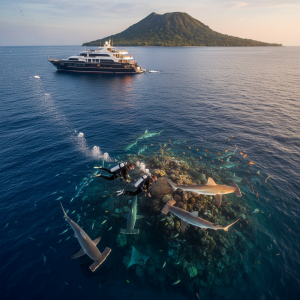
Ultimately, this is a diving expedition, and the quality of the underwater program is paramount. The best liveaboards for diving in the Banda Islands offer a diverse and intelligently structured dive plan. The headline act, of course, is the chance to encounter massive schools of scalloped hammerheads. This typically occurs at offshore seamounts and submerged reefs like Karang Hatta and the aptly named Manuk, or “Bird Island,” known for its sea snakes. These are advanced dives, often involving negative entries in strong currents and profiles that push the limits of recreational diving, with sightings most common between 30 and 40 meters. An expert dive team will brief these challenging dives meticulously and manage the logistics with precision. But Banda is not a one-trick pony. The region offers a full spectrum of world-class diving. The volcanic island of Gunung Api features surreal underwater landscapes of black sand and hardened lava flows, now colonized by pristine hard corals. The visibility here can often exceed 40 meters. In contrast, the itinerary should also embrace the weird and wonderful world of macro life. The muck diving in Ambon Bay is legendary, home to the endemic Ambon scorpionfish, rhinopias, flamboyant cuttlefish, and dozens of nudibranch species. A top-tier liveaboard will carry specialized guides who excel at finding these tiny, bizarre critters. The water temperature hovers at a comfortable 27-29°C, and a 3mm or 5mm wetsuit is generally sufficient. The dive program should include 3-4 dives per day, with opportunities for night dives to witness the nocturnal reef life, a completely different cast of characters from the daytime residents.
Beyond the Reef: The Cultural and Historical Dimension
What truly sets a Banda Sea journey apart from other world-class dive destinations like Raja Ampat or Komodo is its profound historical and cultural resonance. A superior liveaboard experience integrates this unique aspect into the trip. The shore excursion to Banda Neira is a mandatory and memorable highlight. Walking through the quiet streets, you are surrounded by the beautifully preserved remnants of Dutch colonial architecture. The visit to Fort Belgica, a pentagonal fortress built by the Dutch East India Company (VOC) in 1611, offers a commanding view of the harbor and the looming volcano, Gunung Api. A knowledgeable guide will bring the brutal history of the spice monopoly to life. In my experience, the best trips also arrange for a visit to a working nutmeg plantation, where you can see, smell, and taste the spice at its source and learn about its cultivation from local farmers. This connection to the land and its history provides a rich context for the underwater exploration. The Banda Islands are currently on the UNESCO World Heritage tentative list, recognized for their unique role in global maritime history. A voyage here is a visit to a living museum, and the best liveaboards act as your curators. This cultural immersion is a key part of the luxury on offer, transforming a dive holiday into a genuine expedition, a sentiment echoed by the official Indonesia Travel authority which promotes the archipelago’s unique blend of nature and heritage.
Quick FAQ: Your Banda Islands Liveaboard Questions Answered
When is the absolute best time to dive the Banda Islands? The two primary seasons are March-April and September-November. The latter, from mid-September to early November, is widely considered the peak season, offering the best combination of calm seas and the highest probability of encountering large schools of hammerhead sharks.
What is the typical cost for a luxury Banda liveaboard? For a 10- to 12-night expedition on a premier phinisi or motor yacht, you should budget between $6,500 and $9,500 USD per person. This price generally includes all accommodations, meals, diving activities, and land excursions, but excludes flights, park fees, and gratuities.
What level of diving experience is necessary? Due to the remote location, deep dive profiles, and potentially strong currents, a minimum of an Advanced Open Water certification with 50-100 logged dives is strongly recommended. Experience with drift diving and deploying a surface marker buoy is essential for both safety and enjoyment.
How do I travel to the starting point of the cruise? Most itineraries depart from either Ambon (AMQ) in Maluku or Sorong (SOQ) in West Papua. The typical route involves an international flight to Jakarta (CGK) or Bali (DPS), followed by a domestic flight on an airline like Garuda Indonesia to your port of embarkation.
Choosing the right liveaboard for the Banda Sea is an investment in an experience that transcends diving. It is a decision to experience in a world of historical intrigue, geological wonder, and unparalleled marine biodiversity. The vessel is your transport, your hotel, and your expedition base, and its crew are your guides to this forgotten world. For those ready to begin this journey of a lifetime, exploring the curated fleet at Banda Islands Diving is the definitive next step. Our team has personally vetted the vessels that offer the most authentic and refined banda islands diving expeditions, ensuring your voyage to the historic Spice Route is nothing short of extraordinary.