Updated: May 2026
Banda Islands vs. Raja Ampat: Which Is Better for Luxury Diving?
- Exclusivity: Banda has far fewer vessels, ensuring private dive sites.
- Biodiversity: Raja Ampat is the global epicenter of marine species density.
- Topside Experience: Banda offers rich colonial history; Raja features dramatic karst landscapes.
The air hangs heavy with the ghost of nutmeg and the faint, briny scent of the Banda Sea. On the teak deck of a phinisi schooner, the evening’s conversation, held over glasses of chilled chardonnay, inevitably turns to a familiar debate among seasoned divers: Banda or Raja? It’s the ultimate question for anyone seeking the pinnacle of underwater exploration in Indonesia. We’re not talking about which is merely good; we’re talking about which destination delivers the most definitive luxury diving experience. As an editor who has spent considerable time navigating both archipelagos, I can tell you the answer isn’t simple. It’s a nuanced choice between two titans of the Coral Triangle, each offering a profoundly different, yet equally compelling, vision of marine opulence.
A Tale of Two Sanctuaries: Marine Topography and Biodiversity
When comparing banda islands vs raja ampat luxury diving, the underwater canvas is where the distinctions become most vivid. Raja Ampat, often called the “species factory,” is the undisputed champion of sheer biodiversity. Its statistics are legendary. The renowned marine biologist Dr. Gerald R. Allen famously recorded 374 species of fish on a single dive at Cape Kri—a world record that speaks volumes. The region, situated at the heart of the Coral Triangle, features over 1,600 fish species and 75% of the world’s known coral species. Dives here are a kaleidoscopic immersion into vibrant soft corals, enormous schools of fusiliers, and thriving reefs so dense you can hardly see the substrate. For the luxury diver with a passion for macro life and reef health, sites like Misool’s Boo Windows or the Dampier Strait’s Sardine Reef offer an almost overwhelming visual feast. The sheer volume of life is its own form of luxury.
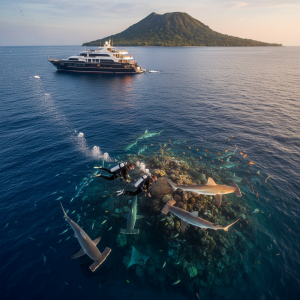
The Banda Islands, however, offer a different kind of underwater grandeur. Forged by volcanic activity along the Ring of Fire, the topography is more dramatic and imposing. Instead of sprawling coral gardens, you find sheer walls plunging into the abyss, immense sea mounts rising from the deep, and black volcanic sand that makes vibrant corals pop. This is pelagic territory. While Banda’s species count is lower than Raja’s, the encounters are often larger in scale. The fall season (September to November) is famous for schooling scalloped hammerheads at sites like Batu Kapal and Karang Hatta. Giant dogtooth tuna, Napoleon wrasse of formidable size, and consistent mobula ray sightings are the norm. The health of the hard coral gardens, particularly around the remote island of Ai, is exceptional, having recovered robustly over the past two decades. The luxury here is not in the quantity of species, but in the quality and scale of the encounters—the thrill of the deep blue and its formidable inhabitants.
The Question of Exclusivity and Remoteness
For many high-end travelers, true luxury is synonymous with solitude. It’s the freedom of having a world-class dive site entirely to yourself. In this arena, the Banda Islands hold a decisive edge. Their remote location, a significant sail from the nearest major port of Ambon, acts as a natural filter. The entire archipelago might only host a half-dozen liveaboards even during peak season. It is not uncommon to spend a full 10-day charter without seeing another dive boat. This translates to an unparalleled sense of discovery; every dive feels like a private expedition. The logistics of getting there—typically a flight to Ambon (AMQ) followed by the liveaboard journey—require more commitment, which in turn preserves the pristine, untouched nature of the experience that defines the banda islands diving ethos.
Raja Ampat, while still remote by global standards, is significantly more accessible and, consequently, more popular. The port of Sorong (SOQ) is the well-established gateway, served by multiple daily flights. This accessibility has fueled a boom in its liveaboard fleet, with upwards of 50 vessels operating during the peak season from October to April. While the area is vast enough to absorb this traffic, the most famous dive sites—Melissa’s Garden, Manta Sandy, and the viewpoints at Wayag—can feel crowded. A luxury operator in Raja Ampat will skillfully manage their itinerary to avoid the rush, but the chance of sharing a site with another group is substantially higher. The luxury in Raja Ampat is less about isolation and more about the quality of the service that insulates you from the crowds, a challenge that simply doesn’t exist on the same scale in Banda.
The Onboard Experience: Phinisi Fleets and Bespoke Service
The vessel itself is a critical component of any luxury diving trip. Both destinations are served by magnificent phinisis—traditional Indonesian two-masted sailing ships reimagined as floating boutique hotels. Raja Ampat, with its more mature luxury market, has a larger and more varied fleet. The top-tier boats here are astonishingly opulent, featuring private balconies, en-suite marble bathrooms, dedicated massage therapists, and even wine cellars. The crew-to-guest ratio is often better than 1:1, with private dive guides, dedicated camera room assistants, and executive chefs crafting multi-course tasting menus. The service is polished, professional, and anticipates every need. If your vision of luxury involves the highest level of creature comforts and a wide selection of world-class vessels, Raja Ampat’s fleet is hard to surpass.
The fleet serving the Banda Islands is smaller and more curated. While vessels of equivalent luxury exist, the defining characteristic is one of expeditionary refinement. The experience is less about resort-style amenities and more about authentic, high-end exploration. The essence of banda islands diving is its boutique nature. The crews often include marine biologists or historians who provide daily lectures, adding a rich intellectual layer to the journey. The smaller number of boats fosters a close-knit community of captains and cruise directors who share information on currents and sightings, ensuring the best possible experience. The luxury here is rooted in expertise and authenticity—sailing with a crew that possesses a deep, intimate knowledge of these historic and challenging waters, providing a safe and enlightening passage through one of the planet’s last frontiers.
Topside Allure: Spices of History vs. Peaks of Nature
A luxury dive trip is more than just what happens 20 meters below the surface. The topside experience provides the cultural and scenic context that elevates a great trip to an memorable one. Here, the two destinations could not be more different. The Banda Islands are steeped in a history that literally changed the world. For centuries, these ten small volcanic islands were the only source of nutmeg and mace, spices once worth more than gold. A land tour on Banda Neira is a walk through a living museum. You can explore the imposing Fort Belgica, a star-shaped fortress built by the Dutch VOC in 1611, wander through colonial-era mansions, and visit still-productive nutmeg plantations where the air is thick with spice. This historical weight, recognized by its inclusion on the UNESCO World Heritage tentative list, offers a profound intellectual and cultural dimension that is unique in the diving world.
Raja Ampat’s allure is one of raw, prehistoric nature. Its signature is the otherworldly landscape of limestone karst islands, sculpted by millennia of wind and water into dramatic mushroom-shaped formations. The quintessential Raja Ampat experience involves an early morning trek to the summit of Piaynemo or the more arduous climb at Wayag. The reward is a vista of turquoise lagoons dotted with countless verdant islets—a scene of almost impossible beauty, heavily promoted by Indonesia’s official tourism board. The cultural encounters here involve visits to remote Papuan villages, offering a glimpse into a traditional way of life that is intimately connected to the sea. The choice for the luxury traveler is between Banda’s layered, poignant history and Raja Ampat’s staggering, elemental beauty.
A Quick FAQ for the Discerning Diver
Is one destination better for underwater photography? — It depends on your subject. For wide-angle shots of vibrant reefs and immense schools of fish, Raja Ampat is unparalleled. Its sheer density of life and color is a dream. For dramatic, high-contrast images of large pelagics like hammerheads against a deep blue background, or unique volcanic topography, the Banda Islands offer a more compelling canvas.
What are the primary diving seasons? — The seasons are nearly opposite, which is why “crossing” or “transition” trips are popular. Raja Ampat’s prime season runs from October through April, when the seas are calmest. The Banda Islands have two main seasons: March-April and September-December. The latter is the famous “hammerhead season.”
How do the costs of a luxury liveaboard compare? — Both destinations represent a significant investment, with top-tier luxury liveaboards commanding prices from $800 to over $1,500 per person, per night. While pricing is comparable for vessels of similar quality, the longer, more expeditionary nature of Banda Sea trips (often 10-12 nights) can result in a higher overall trip cost compared to a standard 7-night Raja Ampat itinerary.
So, which is the ultimate destination in the banda islands vs raja ampat luxury diving debate? Raja Ampat is the grand, opulent symphony—a dazzling performance of biodiversity with a highly polished luxury infrastructure to match. It is the perfect choice for the diver who wants to see everything, all at once, in absolute comfort. The Banda Islands are the rare, single-malt scotch—an experience of deep, complex flavors, rich history, and profound solitude. It is the choice for the connoisseur, the historian, the archivist of rare experiences who understands that the greatest luxury of all is to have a piece of the world, for a fleeting moment, all to oneself.
The decision rests on your personal definition of discovery. To explore the itineraries that define true expeditionary travel and witness the union of history and marine wonder, we invite you to discover our curated banda islands diving journeys. The Spice Islands are waiting.