Updated: May 2026
Banda Islands Liveaboard Prices: A 2024 Luxury Guide
- Pricing is primarily determined by the vessel’s class, cabin selection, and trip duration.
- Peak season rates (September-November) reflect the demand for optimal diving conditions and pelagic sightings.
- Costs are largely all-inclusive, but exclude marine park fees, crew gratuities, and international flights.
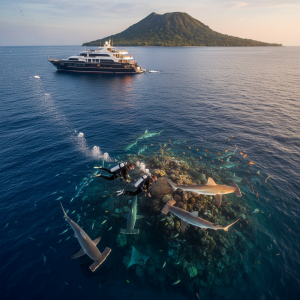
The air hangs heavy, thick with the scent of nutmeg and clove—a fragrant echo of a history that once commanded the world’s attention. Below our phinisi’s bow, the Banda Sea shifts from sapphire to a deep, profound indigo, its surface broken only by the iconic volcanic cone of Gunung Api. This is the feeling of arrival in the Banda Islands, a destination that exists at the intersection of mythic history and raw, untamed nature. For the discerning diver, accessing this remote paradise requires an expedition vessel, a floating basecamp for one of the planet’s most significant underwater odysseys. But navigating the investment for such a trip requires an insider’s perspective. As an editor who has covered the world’s most exclusive destinations, I’ve seen firsthand what separates a mere trip from a true expedition. Here, we dissect the elements that constitute the price of a luxury liveaboard journey through these fabled Spice Islands.
Deconstructing the Cost: What Drives Luxury Liveaboard Pricing in the Banda Sea?
At first glance, the price tag for a Banda Islands liveaboard can seem substantial, but understanding the component parts reveals a clear logic tied to remoteness, quality, and exclusivity. The primary cost driver is, unequivocally, the vessel itself. The market here is dominated by two types of luxury craft: traditional, two-masted Indonesian phinisi schooners and modern, steel-hulled expedition yachts. A journey aboard a vessel like the Sequoia, a handcrafted wooden yacht with just three suites, offers an intimate, highly personalized experience, which is reflected in its price point. In contrast, larger vessels may offer more amenities but host more guests. A standard 11-night itinerary is the norm, a duration dictated by the sheer distance between world-class dive sites. Shorter trips simply cannot do justice to the vastness of the region. Within each vessel, cabin selection introduces another price variable. A top-deck master suite with panoramic windows can command a 30-40% premium over a lower-deck standard cabin. Finally, one must scrutinize the inclusions. A reputable luxury operator will include all meals, non-alcoholic beverages, and an average of 3-4 dives per day. However, the final bill will have additions. Expect to pay for marine park and port fees (around $200 per person), crew gratuity (the industry standard is 10-15% of the trip cost), and any onboard extras like nitrox fills, which can run an additional $250 for a full 10-day trip.
The Tiers of Luxury: From Boutique Phinisi to Expedition Yachts
The spectrum of “luxury” in the Banda Sea is nuanced, and understanding the tiers helps align expectations with investment. The first tier, which I call Boutique Luxury, typically ranges from $5,500 to $6,800 per person. These are often the magnificent phinisis, vessels like the Alila Purnama or the Silolona, which carry between 10 and 16 guests. The experience is defined by impeccable service, gourmet cuisine, and the romanticism of sailing on a traditional ship, albeit one with air-conditioned cabins and en-suite bathrooms. The smaller guest count fosters a sense of camaraderie and allows for a more flexible dive schedule. Stepping up to the Premium Expedition tier, prices move into the $7,000 to $8,500+ range. Here you find vessels like the Pelagian or the Damai I, often purpose-built for diving. These steel-hulled yachts offer superior stability in open-water crossings and cater specifically to underwater photographers with massive camera rooms and individual rinse tanks. The crew-to-guest ratio remains exceptionally high, and you may find added amenities like an onboard masseuse or a more extensive wine list. The pinnacle of Banda Sea travel is the Exclusive Private Charter. Securing a vessel for your private group offers unparalleled freedom to customize the itinerary. Chartering a six-suite phinisi for an 11-night expedition can cost upwards of $120,000, but for those who demand ultimate privacy and control, this represents the zenith of banda islands diving experiences.
Timing is Everything: How Seasonality Affects Your Itinerary and Budget
Unlike other Indonesian diving hotspots that offer year-round access, the Banda Sea operates on a strict, weather-dependent schedule. This limited window of operation is a significant factor in the region’s premium pricing. The absolute peak season runs from late September through early November. During these eight weeks, the seas are typically at their calmest, and visibility can exceed an astonishing 40 meters. This is the prime time for encountering the schooling scalloped hammerheads that congregate at offshore pinnacles like Karang Hatta. The high demand for these specific dates means that premier vessels are often fully booked 18 to 24 months in advance. There are no last-minute deals for peak season; the value is in securing a coveted spot. A second, slightly less predictable season occurs from March to May. The weather is generally favorable, and the diving remains world-class, with a greater emphasis on reef health and macro life as water temperatures are a degree or two warmer. You may find slightly more availability during this shoulder season, but prices do not drop significantly. From June to August, the monsoon season makes the seas largely impassable, and no reputable liveaboards operate in the area. This scarcity, concentrated into just a few months per year, ensures that demand consistently outstrips supply, cementing the Banda Islands’ status as an exclusive and high-value diving destination, as noted by Indonesia’s official tourism board.
Beyond the Base Price: Factoring in the “Hidden” Costs of a Remote Expedition
The liveaboard price is the core of your budget, but a successful expedition to the Banda Islands requires accounting for several ancillary costs. The journey itself begins with international flights to Jakarta (CGK) or Bali (DPS), followed by a domestic flight to Ambon (AMQ), the primary port of embarkation. Depending on your origin and carrier like Garuda Indonesia, these connecting flights can add $500 to $800 to your total. Upon boarding, you will be asked to settle the aforementioned marine park and harbor fees, which typically amount to $150-$200 per person and are paid in cash. Perhaps the most significant additional expense is the crew gratuity. A 10-15% tip is standard practice and deeply appreciated by the hard-working local crew. On a $7,500 trip, this means budgeting an additional $750 to $1,125. Then there are the personal onboard expenses. Nitrox certification is highly recommended to maximize bottom time, and a package for the entire trip usually costs between $200 and $250. Alcoholic beverages, satellite internet access (which is often slow and expensive), and any specialized gear rentals will also be added to your final bill. Finally, comprehensive travel and dive insurance is not a suggestion; it is a requirement by all top-tier operators. A policy from an organization like Divers Alert Network (DAN) that includes remote medical evacuation coverage is essential for peace of mind in such an isolated location.
The Unquantifiable Value: What Your Investment Truly Buys
While we can meticulously itemize costs, the true return on an investment in a Banda Islands trip is measured in experiences that defy a balance sheet. You are paying for a level of remoteness that is increasingly rare on our planet. The Banda Islands were the original “Spice Islands,” a tiny archipelago that was once the sole source of nutmeg and mace, making it the epicenter of global trade and conflict for centuries. Today, that isolation has preserved one of the most vibrant marine ecosystems on Earth. The investment grants you front-row seats to incredible pelagic events—the silent glide of a squadron of mobula rays, the overwhelming spectacle of a thousand schooling jacks, and the adrenaline-fueled search for hammerheads in the deep blue. But the experience extends beyond the water. You will walk through history, exploring 17th-century Dutch forts and wandering through nutmeg plantations that have been cultivated for generations. This historical and cultural depth, a narrative recognized by its inclusion on UNESCO’s Tentative World Heritage list, elevates the journey from a simple dive trip to a profound exploration of place. A significant portion of the marine park fees you pay is funneled directly back into local conservation efforts, meaning your presence contributes to the protection of this irreplaceable natural and historical treasure. This is the essence of luxury travel today: exclusivity, authenticity, and a positive impact. When you book a top-tier banda islands diving liveaboard, you are not just buying a vacation; you are funding the preservation of a legend.
Quick FAQ: Your Banda Islands Liveaboard Price Questions Answered
Is a Banda Islands liveaboard more expensive than other Indonesian destinations like Raja Ampat or Komodo?
Yes, on average, it is. The primary reasons are the longer, more fuel-intensive itineraries (typically 10-12 nights versus 7-9 in Komodo), the extremely short operational season which concentrates demand, and the complex logistics of provisioning vessels in such a remote area. Expect to pay approximately 15-25% more for a Banda Sea trip than for a Raja Ampat itinerary of a similar quality and duration.
Can I find a “budget” liveaboard in the Banda Islands?
True budget options are virtually nonexistent in the Banda Sea, and for good reason. The operational challenges and safety requirements for crossing the open sea demand a high standard of vessel maintenance and crew expertise. The entry point for a reputable, safe, and well-run operation falls squarely in the boutique luxury category, starting at around $5,500 for a full itinerary. Anything significantly lower should be approached with extreme caution.
How far in advance should I book to get the best price?
Unlike many travel products, booking early for the Banda Islands is not about securing a discount but about securing a spot. The limited number of cabins during the brief peak season means the best vessels are often sold out 18-24 months in advance. The “best price” is the standard rate for your preferred cabin and dates. Last-minute deals are almost unheard of; the demand is simply too high.
An expedition to the Banda Sea is an investment in one of the last truly wild places where history and nature collide with spectacular force. The price reflects the immense logistical effort required to operate at the highest levels of comfort and safety in such a remote corner of the globe. It is a journey for the discerning traveler who understands that the most valuable luxuries are not amenities, but access, solitude, and the chance to witness something truly extraordinary. To begin planning your own expedition into the heart of the Spice Islands, explore our curated collection of banda islands diving voyages and discover the vessel that will carry you on this memorable journey.